
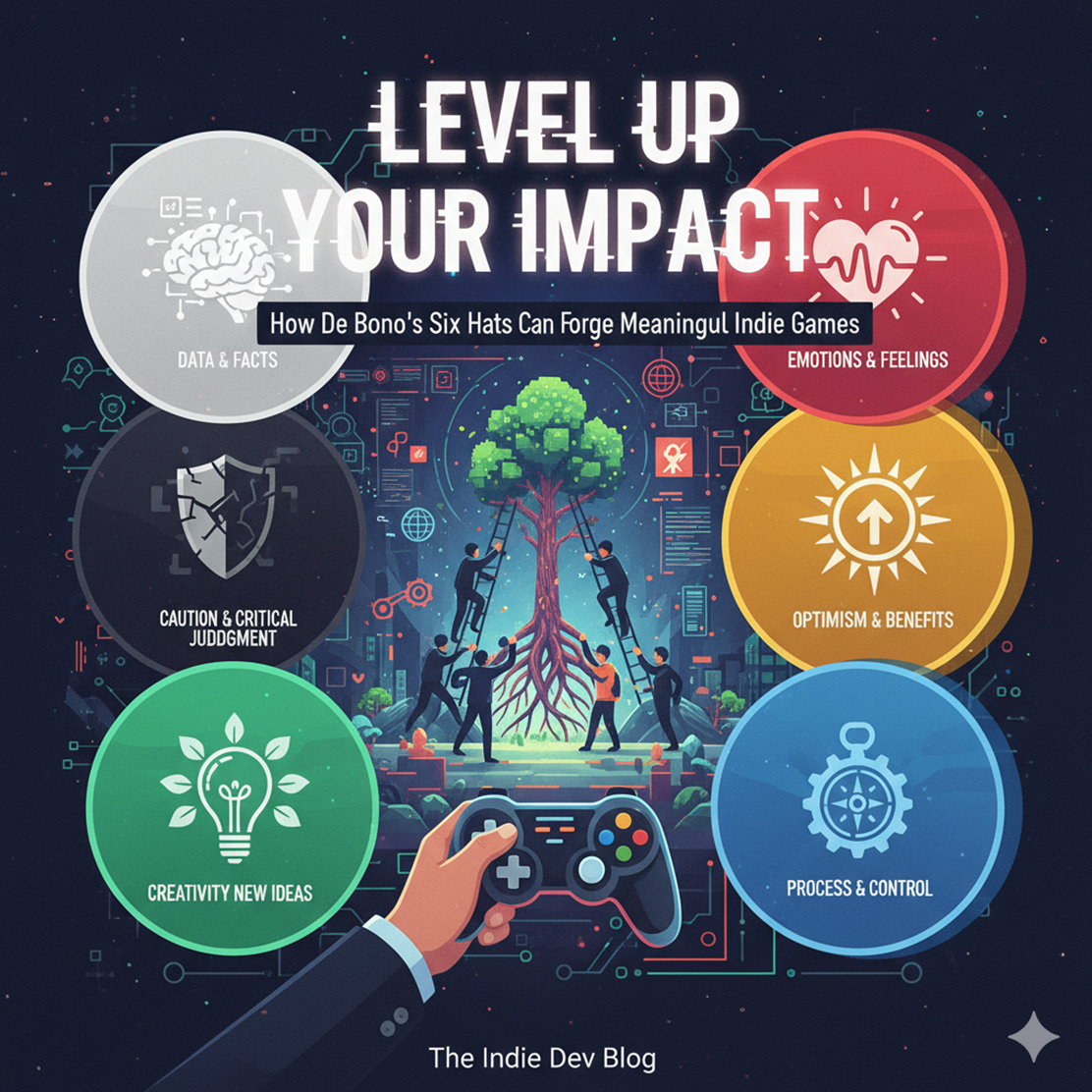
AI generated image based on De Bono’s six Thinking Hats
How De Bono's Six Hats Can Forge Meaningful Indie Games
The world of indie game development is a vibrant, innovative space, often fuelled by passion and a desire to create unique experiences. But what if that passion could also be harnessed for a greater good? We’re talking about indie games designed with a powerful social cause in mind – games that educate, inspire, and drive real-world change.
But creating such impactful experiences isn’t just about good intentions; it requires a structured approach to problem-solving and decision-making! That’s where famous Edward de Bono’s “Six Thinking Hats” can be a game-changer. This powerful framework encourages parallel thinking, allowing developers to explore different perspectives. Let’s see how the hats can help you elevate your socially conscious indie games.
1. The White Hat: The Data & Facts Hat
This is the step where you gather all the crucial information about your chosen social cause. What are the statistics? What are the key challenges? Who are the affected communities?
For example, if your game tackles climate change, white hat thinking means researching current global warming data, the science behind renewable energy, and successful community initiatives. It’s about understanding the core problem your game aims to address.
2. The Red Hat: The Emotions & Feelings Hat
This hat encourages you to tap into the emotional landscape surrounding your cause. How does it make you and others feel? What are the hopes, fears, and frustrations? This perspective is vital for crafting emotionally resonant narratives and player experiences.
For a game about mental health awareness, red hat thinking would involve exploring the stigma, the feelings of isolation, and the hope for recovery. This helps you design characters and storylines that evoke empathy and understanding.
3. The Black Hat: The Caution & Critical Judgment Hat
The black hat is about identifying potential pitfalls, risks, and challenges. What could go wrong? What are the ethical considerations? Are there any unintended negative consequences of your game’s message or mechanics?
If your game, for example, aims to promote safe internet practices, black hat thinking would involve considering how it might be misused, potential privacy concerns, or if the message could be misconstrued by different age groups.
4. The Yellow Hat: The Optimism & Benefits Hat
Now is the time to focus on the positive sides! What are the potential benefits of your game? How can it effectively contribute to the social cause?
For a game promoting biodiversity, yellow hat thinking would explore how players can experience the joy of preserving ecosystems, the benefits of sustainable living, and the positive impact of collective action. It’s about showcasing the upside and inspiring action.
5. The Green Hat: The Creativity & New Ideas Hat
This is the hat for brainstorming new mechanics, innovative storytelling approaches, and fresh ways to engage players. How can you make your social message engaging, fun, and impactful without being preachy?
Green hat thinking might lead to unique gameplay where players manage resources in a struggling community and solve complex logistical challenges.
6. The Blue Hat: The Process & Control Hat
The blue hat is the conductor of the whole orchestra. It manages the thinking process itself. How will you organize your team’s discussions? This hat is about setting goals, defining next steps, and ensuring a smooth development journey.
For any socially conscious game project, blue hat thinking involves setting clear milestones for research, design, development, and impact assessment.
So, by adopting consciously each of de Bono’s Six Thinking Hats, indie game developers can move beyond simply creating a game about a social cause. They can craft experiences that are well-researched, emotionally impactful, ethically sound, engaging and efficiently developed.
So, next time you’re embarking on a meaningful indie game project, try to put on De Bono’s six hats!
References
De Bono, E. (1985). Six Thinking Hats. Little, Brown and Company.
da Silva, M. M. S. C., Mota, M. H. de S., & Vasconcelos, M. I. de A. L. (2021). Serious games as social innovation tools [Preprint]. ResearchGate. Retrieved from https://www.researchgate.net/publication/357363550_Serious_games_as_social_innovation_tools
Indienomicon. (2023). Indie games and social impact: Addressing important themes through interactive storytelling. Indienomicon. Retrieved from https://indienomicon.com/indie-games-and-social-impact-addressing-important-themes-through-interactive-storytelling/